 French
 English
 Spanish
 Arabic
 Japanese
 Korean
 Russian
 German
 Portuguese
 Italian
 Turkish


If you are choosing between thermoelectric cooling vs compressor, the right answer depends on what matters most in your hotel, guest room, or commercial refrigeration project.
Choose thermoelectric cooling when silent operation, vibrationless cooling, compact design, and low maintenance matter most. Choose compressor cooling when you need stronger cooling capacity, better energy efficiency, faster pull-down, lower long-term cost per unit of cooling, and more stable temperature control in hot environments.
That is the real difference.
For many hotels, the minibar is not just a small refrigerator. It is part of the guest experience, room design, energy strategy, and daily operation. A minibar that runs quietly helps guests sleep. A minibar that struggles to stay cold creates complaints. A minibar that looks modern but drives up energy consumption hurts margins.
This guide breaks down thermoelectric minibars, compressor minibars, and where minibars d'absorption still fit, so you can choose the best minibar for your application.
What Is Thermoelectric Cooling?
A thermoelectric cooler (TEC) uses the Peltier effect. When electric current passes through a semiconductor module, one side becomes cold and the other side becomes hot. That is why thermoelectric cooling is also called:
- solid-state cooling
- Peltier cooling
- TEC cooling
A thermoelectric unit does not rely on a traditional compressor, piston, cylinder, or refrigerant-based vapor-compression cycle. Instead, it uses a Peltier module, heat sink, fan, power supply, and control system to move heat.
In simple terms, it acts like a compact electric heat pump.
Key parts of a thermoelectric cooling system
A thermoelectric cooling system is usually equipped with:
- a Peltier element
- semiconductor couples
- a heat sink
- fan-assisted air flow
- a thermostat
- voltage and current controls
- insulation and cabinet ventilation paths
This technology is popular in compact applications where silent refrigeration, low vibration, and a clean, modern look matter more than raw cooling power.
What Is Compressor Cooling?
Compressor cooling uses vapor-compression refrigeration, also called mechanical cooling ou refrigerant-based cooling.
This system moves a refrigerant through a closed loop that includes:
- compressor
- condenser
- expansion valve or capillary device
- evaporator
The compressor raises refrigerant pressure. The condenser releases heat. The expansion stage drops pressure. The evaporator absorbs heat from the cabinet space and creates cooling.
This is the most common refrigeration technology in refrigerators, freezers, beverage coolers, and commercial systems because it offers strong cooling capacity and better coefficient of performance (COP) in most real-world loads.
Common refrigerant considerations
Modern compressor systems may use refrigerants such as R134a ou R1234yf, depending on the design, regulations, and environmental targets. Refrigerant selection affects:
- GWP (Global Warming Potential)
- ODP (Ozone Depletion Potential)
- service requirements
- environmental compliance
- long-term operating strategy
That matters because the cooling debate is not just about temperature. It is also about environmental impact, leak risk, efficiency, and lifecycle cost.
Thermoelectric Cooling vs Compressor: The Core Difference
The biggest difference is this:
Thermoelectric cooling prioritizes silence, simplicity, and compact design. Compressor cooling prioritizes cooling performance, efficiency, and stronger temperature control.
Here is the quick comparison.
| Factor | Thermoelectric Cooling | Compressor Cooling |
|---|---|---|
| Cooling method | Peltier effect / solid-state cooling | Vapor-compression refrigeration |
| Noise level | Very low, often near-silent | Low to moderate, depends on design |
| Vibration | Minimal | Some vibration |
| Cooling capacity | Lower | Higher |
| Energy efficiency | Usually lower at larger loads | Usually higher |
| Temperature pull-down | Slower | Faster |
| High ambient performance | More limited | Better |
| Maintenance | Low | Moderate |
| Refrigerant fluid | No liquid refrigerant loop in the cooling module | Uses refrigerant |
| Best for | Quiet minibars, electronics, niche compact cooling | Hotels, refrigerators, medical, commercial cooling |
Why Hotels Care About This Choice
In a hotel or other hospitality establishments, the minibar must do more than cool drinks.
It must:
- protect the guest expérience
- stay quiet at night
- fit the room design
- maintain safe product temperature
- keep energy consumption under control
- support easy maintenance
- look clean and modern
- work reliably across many rooms
That is why thermoelectric minibars, minibars d'absorption, and compressor minibars are all discussed in hospitality buying decisions.
Thermoelectric Minibars: Where They Win
A thermoelectric minibar is attractive because it is quiet, simple, and visually clean. In a modern hotel room, that matters.
Main advantages of thermoelectric minibars
1. Silent operation improves guest comfort
Thermoelectric cooling is known for silent or near-silent operation. There is no compressor cycling on and off, so the minibar does not create the same level of noise or vibration. That can improve the guest experience, especially in premium rooms, suites, and sleep-focused concepts.
2. Vibrationless cooling suits sensitive applications
Because there is very little vibration, thermoelectric cooling works well in spaces where product stability matters. This is one reason it appears in some electronics, compact laboratory equipment, and specialty cooling applications.
3. Compact design and flexible integration
Thermoelectric systems are compact. That helps when cabinet space is limited or when you want a sleek, built-in unit. They also fit glass door concepts and minimalist furniture more easily.
4. Low maintenance
There are fewer moving mechanical parts than in compressor systems. That can reduce routine service complexity. To maintain performance, staff still need to clean ventilation paths, fans, filters, and cabinet surfaces.
5. No traditional refrigerant loop
A thermoelectric unit does not depend on a typical compressor refrigerant circuit, so there is no refrigerant leak risk in the same way as vapor-compression systems.
Where Thermoelectric Cooling Falls Short
Thermoelectric cooling is not the best answer for every minibar.
Main drawbacks of thermoelectric cooling
1. Lower energy efficiency
This is the biggest issue. In many real applications, thermoelectric cooling has a lower COP than compressor systems. That means it may consume more electricity for the same cooling result.
If you manage many hotel rooms, lower efficiency can raise annual energy consumption and total operating cost.
2. Lower cooling capacity
A thermoelectric cooler works best for small loads and moderate temperature differences. It is less effective when ambient heat is high or when the minibar must recover temperature quickly after repeated door openings.
3. Performance drops in hot climates
In high ambient temperatures, thermoelectric cooling becomes less competitive. The hot side must reject heat efficiently. If the cabinet lacks proper ventilation, cooling performance drops even faster.
4. Heat management is critical
The technology may look simple, but good system design still matters. Heat sink size, fan performance, cabinet airflow, insulation, and thermostat logic all contribute to performance.
Compressor Cooling: Where It Wins
A compressor system is still the workhorse of the refrigeration world.
Main advantages of compressor cooling
1. Better energy efficiency
For most practical refrigeration loads, compressor cooling delivers better l'efficacité énergétique and higher coefficient of performance (COP) than thermoelectric cooling.
That is why compressor units are common in refrigerators, beverage coolers, medical refrigeration, and commercial cold storage.
2. Stronger cooling capacity
Compressor systems move more heat. They can cool faster, handle more product load, and hold constant cabinet temperatures more effectively.
3. Better temperature control
If your priority is reliable cold storage, compressor cooling is usually the safer choice. It is better for units that must stay cold even when the room is warm, the door opens often, or the minibar holds a heavier load.
4. Better for hot environments
In hot regions, during peak summer, or in rooms with limited airflow, compressor cooling usually performs better than thermoelectric cooling.
5. Lower lifecycle cost in many commercial settings
A compressor unit may cost more upfront in some designs, but its stronger efficiency can lower total cost over time, especially across a large hotel portfolio.
Where Compressor Cooling Falls Short
Compressor technology is powerful, but not perfect.
Main drawbacks of compressor cooling
1. More noise
Even a good compressor system creates some sound. The level may be low, but it is rarely as quiet as a solid-state thermoelectric minibar.
2. More moving parts
A compressor system includes mechanical components, refrigerant circulation, and more complex service needs. That can mean higher maintenance requirements over time.
3. Refrigerant considerations
Compressor cooling depends on refrigerants. That introduces environmental, regulatory, and service considerations around R134a, R1234yf, leak prevention, recovery, and system compliance.
What About Absorption Minibars?
Because the minibar market often compares three technologies, it is worth addressing minibars d'absorption too.
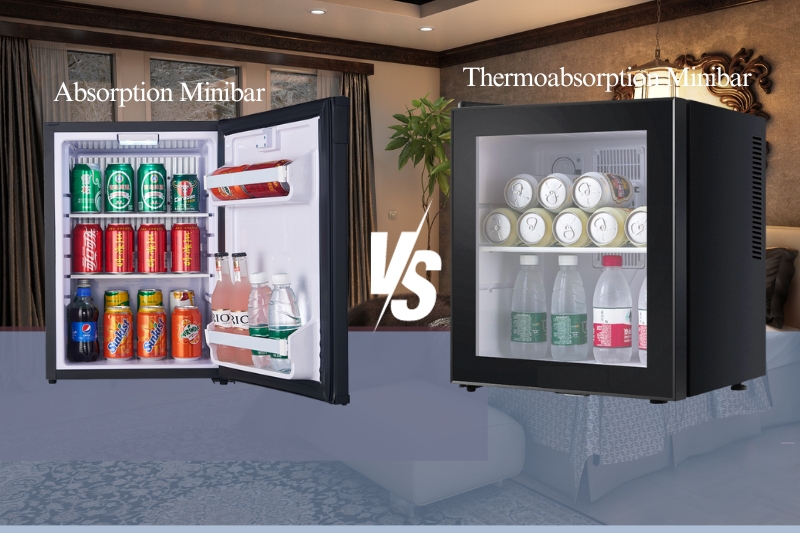
Absorption technology is valued because it can also run very quietly. That makes it attractive for hotels. But many operators now look at absorption carefully because of its energy consumption. In many use cases, absorption is less efficient than modern compressor designs.
So the real hospitality choice often becomes this:
- choose thermoelectric minibars when ultra-quiet operation and compact design lead the decision
- choose compressor minibars when performance, efficient cooling, and operating cost matter most
- consider absorption minibars only when silent operation is essential and the energy tradeoff still makes sense
Energy Consumption and Efficiency: The Buying Decision Most Hotels Miss
If you want to choose the right minibar, do not stop at purchase price.
Do a real cost-benefit analysis based on:
- upfront unit cost
- annual power use
- capacité de refroidissement
- room ambient temperature
- maintenance hours
- expected lifespan
- replacement cycle
- guest complaints
- brand positioning
A minibar may offer a lower purchase price but cost more in electricity every year. Another unit may cost more upfront but reduce long-term operating expense.
That is why the best minibar is not just the quietest or the cheapest. It is the unit that matches your room concept, climate, energy budget, and service model.
Noise, Vibration, and Guest Experience
For many hotels, this is where thermoelectric cooling still has a strong advantage.
A minibar that hums, clicks, or cycles loudly at night can damage the in-room experience. Guests notice noise more when the room is quiet, especially in upscale hospitality settings.
That is why silent refrigeration et vibrationless cooling remain strong selling points for thermoelectric designs.
On the other hand, if guests complain that drinks are not cold enough, silent operation loses its value. Comfort is not just acoustic. It also includes product performance.
Temperature Control, Thermostat Accuracy, and Cabinet Design
A good minibar must do more than cool once. It must maintain a stable internal environment.
That depends on:
- cabinet insulation
- thermostat quality
- automatic control logic
- ventilation
- door seal quality
- ambient room heat
- product load
- door opening frequency
Modern hotel units may be equipped with an automatic thermostat, intelligent control systems, efficient air circulation, and optimized cabinet design. A glass door minibar may improve display and upselling, but it also changes heat gain and system requirements.
If precise temperature control matters, compressor cooling is usually stronger. If low noise matters more, thermoelectric may still be the better fit.
Environmental Impact: Which Technology Is More Environmentally Friendly?
This question needs an honest answer.
A lot of people assume thermoelectric cooling is automatically more environmentally friendly because it does not use a traditional refrigerant loop. That is only part of the story.
Thermoelectric environmental profile
Thermoelectric cooling avoids direct refrigerant leakage concerns. That is a real advantage. But if the unit has lower efficiency and uses more electricity, the total energy footprint may be higher over time.
Compressor environmental profile
Compressor systems depend on refrigerants, so GWP et ODP matter. But a highly efficient compressor design can reduce total electricity use. That may improve whole-life environmental performance, depending on the refrigerant, grid mix, and use case.
So the environmentally friendly answer is not based on one feature. It must be based on:
- refrigerant choice
- annual energy consumption
- operating climate
- lifespan
- maintenance quality
- life cycle assessment
Reliability and Lifespan
Both systems can be reliable when they are designed well.
Thermoelectric reliability
Thermoelectric modules have no compressor and fewer mechanical parts. That can reduce some failure points. But the system still depends on heat dissipation, electronics, fan reliability, and clean airflow.
Compressor reliability
Compressor systems have more moving parts, but they are mature technologies with strong real-world track records. A well-designed compressor unit can offer excellent long-term reliability.
In short:
- thermoelectric cooling offers simplicity
- compressor cooling offers mature performance
Best Applications for Each Technology
Thermoelectric cooling is best for:
- hotel minibars where silence matters most
- premium guest rooms
- compact beverage coolers
- electronics cooling
- portable medical devices
- aerospace applications
- specialty laboratory equipment
- low-vibration, low-noise installations
Compressor cooling is best for:
- hotels that prioritize stronger cooling performance
- modern hotel minibars in warm climates
- beverage refrigerators
- medical refrigeration
- vaccine storage
- industrial freezers
- commercial refrigerators
- heat pumps
- data center and process cooling support systems
Pour vaccine storage, compressor-based systems are usually the stronger choice because strict temperature consistency is critical. For portable medical devices, thermoelectric cooling may be attractive where size, weight, and silent operation matter.
Engineering View: Why the Performance Gap Exists
If you want the technical answer, the performance gap comes down to heat transfer and system physics.
Thermoelectric cooling depends on:
- semiconductor performance
- Peltier coefficient
- current and voltage control
- hot-side heat rejection
- heat sink design
- fan efficiency
- temperature difference across the module
Compressor cooling depends on:
- refrigerant properties
- compressor efficiency
- condenser and evaporator performance
- expansion device control
- pressure ratio
- heat exchanger design
Engineers often use system modeling, CFD simulation, finite element analysis, exergy analysis, and life cycle assessment to compare these technologies in real applications.
That matters because lab performance and field performance are not always the same. Cabinet design, ambient air, insulation, and control logic can change the result.
How to Choose the Right Minibar or Cooling Technology
Before you buy, ask these questions:
1. Is silent operation the top priority?
If yes, thermoelectric or absorption may be the better fit.
2. Do you need stronger cooling in hot rooms?
If yes, compressor cooling is usually the better option.
3. Is annual energy cost a major concern?
If yes, compare real energy consumption, not just product claims.
4. Will the unit sit behind furniture with limited ventilation?
If yes, design becomes critical. Thermoelectric systems especially require proper heat rejection.
Both technologies can support this, but the cooling load must be matched correctly.
6. Are maintenance teams available on site?
If staffing is light, a simpler low-maintenance design may help.
Final Verdict: Thermoelectric Cooling vs Compressor
For most commercial refrigeration and high-performance minibar use, compressor cooling is the stronger all-around choice. It offers better cooling capacity, better energy efficiency, better temperature recovery, and better performance in demanding environments.
For quiet guest-room use where noise matters more than raw cooling power, thermoelectric cooling still offers a strong value proposition. It is silent, compact, low-vibration, and easy to integrate into a modern hotel room.
So which is better?
Thermoelectric cooling is better for silence, sleek design, and low-vibration hospitality use. Compressor cooling is better for efficiency, stronger refrigeration, better temperature stability, and long-term performance.
That is the difference that should guide your decision.
FAQ: Thermoelectric Cooling vs Compressor
Is thermoelectric cooling better than compressor cooling?
It is better only when silent operation, compact design, and low vibration are more important than cooling power and efficiency.
Do thermoelectric minibars use refrigerant?
No traditional vapor-compression refrigerant loop is used in the cooling module. They rely on the Peltier effect.
Are compressor minibars louder?
Usually yes, but many modern systems are still low-noise. They are just not as silent as thermoelectric or absorption systems.
Which has lower energy consumption?
In most real refrigeration loads, compressor cooling has lower energy consumption for the same cooling result.
Which is more environmentally friendly?
It depends on total system design. Thermoelectric cooling avoids refrigerant leakage concerns, but compressor systems may use less electricity. The best answer depends on GWP, ODP, energy use, and lifecycle analysis.
What is the best minibar for a hotel?
The best minibar is the one based on your room concept, guest expectations, acoustic target, climate, maintenance capacity, and energy budget.
If you are comparing minibars for a hotel, serviced apartment, or hospitality project, do not choose based on price alone. Look at noise, temperature control, energy consumption, ventilation requirements, maintenance, and lifecycle cost before you choose. That is how you select a minibar that works for guests, operations, and profit.